Ask a laboratory how large a product its 3 m chamber can take and the answer is usually the quiet zone: the volume over which normalised site attenuation was validated, often 2 m across. For a long time that was the only answer the standards gave. Since 2019 the basic standard for radiated measurements gives a second one, and it is smaller. It depends on the distance to the antenna, not on how good the chamber is.
- CISPR 16-2-3:2016 with Amendment 1:2019 adds clause 7.1.2, which lists the maximum EUT volume for each measurement method and distance. From 30 MHz to 1 GHz on an OATS or in a SAC it is a cylinder 1.5 m in diameter and 1.5 m high at 3 m, and 2.0 m by 2.0 m at 5 m, including the cables.
- Those two entries are maximums. The 10 m entry, 5.0 m by 4.0 m, is a recommendation, because 10 m is treated as a protection distance.
- CISPR 14-1:2020 and CISPR 11:2024 already name the amended text, so the table applies to appliances and to industrial, scientific and medical equipment today. CISPR 32 with its 2019 amendment names the 2016 edition but sets aside its additional requirements, so multimedia equipment is the large family still to come. Equipment between 1.5 m and 2.0 m is the group that needs 5 m.
What the amendment says
The amendment's own introduction states its purpose in one line: EUT volume specifications for radiated disturbance measurements, depending on test method and on measurement distance. It adds a definition, 3.1.35, of a small EUT: equipment, including its cables, on a table or standing on the floor, that fits in a cylindrical volume of 1.5 m in diameter and 1.5 m in height at a 3 m measurement distance, or 2.0 m by 2.0 m at 5 m, on an OATS or in a SAC. It then replaces the old introductory clause with a new 7.1.2, an overview of maximum EUT volumes by method, frequency range and distance.
| Measurement distance | 3 m | 5 m | 10 m | 30 m |
|---|---|---|---|---|
| OATS or SAC, 30 MHz to 1 GHz Table 11, diameter by height | 1.5 m by 1.5 m | 2.0 m by 2.0 m | 5.0 m by 4.0 m, recommendation | 15 m by 4.0 m, recommendation |
| FAR, 30 MHz to 1 GHz Table 11 | 1.5 m by 1.5 m | 2.0 m by 2.0 m | 3.0 m by 3.0 m | Not listed |
| Absorber-lined OATS, SAC or FAR, 1 GHz to 18 GHz Table 12, recommended | 1.5 m by 1.5 m | 2.0 m by 2.0 m | 5.0 m by 3.0 m | Not listed |
Three details in the footnotes matter as much as the numbers.
- 3 m and 5 m are limits; 10 m and 30 m are not. The footnote to the 10 m and 30 m entries says they are a recommendation only, because those distances may be regarded as protection distances, and any EUT volume encompassed by the receive antenna's beamwidth is accepted provided the test volume meets the validation criteria. No such footnote is attached to 3 m or 5 m.
- The reason is the near field. The amendment defines the near-field effect as the deviation from far-field propagation close to the EUT. A large source at a short distance is not seen by the antenna as a point, and the rays from its top, centre and bottom do not add as the 10 m limit assumes. CISPR 16-4-2 puts a number on it in its own comments: for an EUT 1.5 m high at 3 m, the field reduction at 1 GHz is about 4 dB, it is larger for larger EUTs, and it is not included in the published uncertainty.
- Above 1 GHz the same sizes are recommended "for reduced near-field uncertainty", together with minimum antenna beamwidths of 28° at 3 m and 22.6° at 5 m and 10 m, so that the antenna actually sees the whole volume.
The table's note also says that work is in progress to define conditions for medium-sized EUT volumes. The standard already expects a class of equipment that is neither small nor suited to a short distance.
Where it is cited
CISPR 16-2-3 is the basic standard for radiated disturbance measurement, and every CISPR product standard calls it up for the method. Whether the size table applies to a given test depends on which edition the product standard names, because the references are dated. Reading the normative references of the current editions gives a clear picture: two product standards already name the amendment, and the largest one has deliberately kept it out for now.
| Current edition | Edition of CISPR 16-2-3 it names | Consequence for EUT size |
|---|---|---|
| CISPR 11:2024 industrial, scientific, medical | 2016 with Amendment 1:2019 and Amendment 2:2023 | Clause 7.1.2 comes with the reference. This is the most recent product standard and it names the amended text in full. |
| CISPR 14-1:2020 appliances and tools | 2016 with Amendment 1:2019 | The first product standard to name the amendment. The earlier edition already told laboratories to consider the basic standards' recommendations for a large EUT at 3 m; the reference now supplies the number. |
| CISPR 32:2015 with A1:2019 multimedia equipment | 2016, without the amendment | The amendment to CISPR 32 adds a sentence that requirements of CISPR 16-2-3:2016 which conflict with or are in addition to its own shall not be followed. The EUT volume remains the one from site validation, and the FAR rule of less than half the measurement distance is kept. |
| CISPR 15:2018 lighting | 2016, published a year before the amendment | Not invoked by reference. |
| CISPR 16-1-4:2025 test sites | Cites Table 10 of CISPR 16-2-3:2016/AMD1:2019 by name | The EUT shall not exceed the validated test volume, which is "also limited by" the CISPR 16-2-3 table. |
The editions these replaced, which many laboratories are still accredited to, all name the 2010 text. They show why the amendment was written, because each had the idea in a different form.
| Previous edition | Its own rule on EUT size and distance |
|---|---|
| CISPR 11:2015 with A1:2016 | Small size equipment: a cylinder 1.2 m in diameter and 1.5 m high, including cables. The 3 m distance applies only to equipment that meets it. |
| CISPR 32:2015 | In a SAC, within the measurement volume demonstrated during site validation. In a FAR, maximum width and height including cables less than half the measurement distance, which is 1.5 m at 3 m. |
| CISPR 14-1:2016 | 10 m, or closer down to 3 m, in which case "the recommendations of the CISPR basic standards shall be considered when testing large EUT" near 30 MHz. |
| CISPR 15:2015 | 3 m or 10 m, with a note to take care with a large EUT at 3 m near 30 MHz because of near-field effects. |
One standard had a number, one had a ratio but only for a FAR, and two had a warning with no number at all. Amendment 1 puts one table in the basic method that all of them share, gives the OATS and the SAC the limit the FAR already had, and extends it to 5 m.
What it changes today
- Under CISPR 11:2024 and CISPR 14-1:2020 the table already applies. A laboratory accredited to those editions has 1.5 m by 1.5 m at 3 m and 2.0 m by 2.0 m at 5 m in its referenced method today. Where the product standard sets a tighter limit of its own, as CISPR 11 has long done with its 1.2 m small size equipment definition for 3 m, the tighter one governs, and the basic standard adds what the product standard does not cover, such as the 5 m entry.
- Under CISPR 32 the binding rule in a SAC is still the validated test volume. A chamber with a 2 m quiet zone at 3 m may take a product 2 m across, because the amendment to CISPR 32 sets aside additional requirements of the basic standard. In a FAR the half-distance rule already gives 1.5 m at 3 m.
- Laboratories still accredited to the previous editions work to the rules in the second table until their scope moves on, which for most is the next transition date set by the regulator or the accreditation body.
- Below 30 MHz, the link is already made through CISPR 16-1-4:2025, which limits the test volume by the amendment's table as well as by the NSIL validation.
- For the measurement result, the near-field error does not depend on which reference is in force. A 1.9 m rack measured at 3 m carries an error the uncertainty budget does not contain, and the same rack measured at 10 m in another laboratory will not give the same margin. That shows up as disagreement between laboratories long before it shows up as a non-conformity.
- For a laboratory that tests to several product standards in one chamber, the strictest reference on the scope sets the practice. Once CISPR 11:2024 or CISPR 14-1:2020 is on the scope, checking EUT size against distance becomes part of the procedure for every job.
What is foreseeable
The pattern is already visible. Each product standard revised since 2019 has named the amended text, and the one that has not, CISPR 32, excluded it by a sentence in an amendment rather than by a technical argument. Its next edition is the foreseeable change: when multimedia equipment follows CISPR 11 and CISPR 14-1, 1.5 m by 1.5 m becomes the limit at 3 m for the largest product family of all. The products affected are easy to list because the cylinder includes the cables and is measured across the widest dimension.
| Equipment | Typical size | Against the 3 m limit | Against the 5 m limit |
|---|---|---|---|
| 75-inch display | About 1.7 m wide | Over | Within |
| 42U equipment rack | About 2.0 m high | Over | At the limit |
| Control cabinet or drive enclosure | 1.8 m to 2.0 m high | Over | Within or at the limit |
| Hospital bed, imaging trolley, large medical cart | About 2.0 m long | Over | At the limit |
| Multifunction printer, vending or kiosk unit | 1.2 m to 1.8 m high | Often over with cables | Within |
| EV charging cabinet, energy storage unit | 2.0 m and above | Over | Depends on the model |
Two further developments are signalled in the text itself. The medium-sized EUT category is under development, and conditions for it are more likely to mean additional requirements at short distances than a relaxation of them. And the sizes above 1 GHz, which are recommendations today, sit in the same clause and follow the same reasoning, so a future edition can harden them without a new argument. A laboratory planning a chamber that has to last twenty years should plan for the table, not for the dated reference it happens to work to this year.
Why 5 m is the sensible step
For equipment that no longer fits 1.5 m, the choice is between 5 m and 10 m. The table makes the case for 5 m clearly. It takes the volume from 1.5 m to 2.0 m in both directions, which is where most of the products in the list above sit. The conversion from a 10 m limit is 6 dB at 5 m against more than 10 dB at 3 m, so less of the result rests on an assumed fall-off. And a 5 m chamber stays in the height class of a 3 m chamber, which means an ordinary industrial building rather than a purpose-built hall.
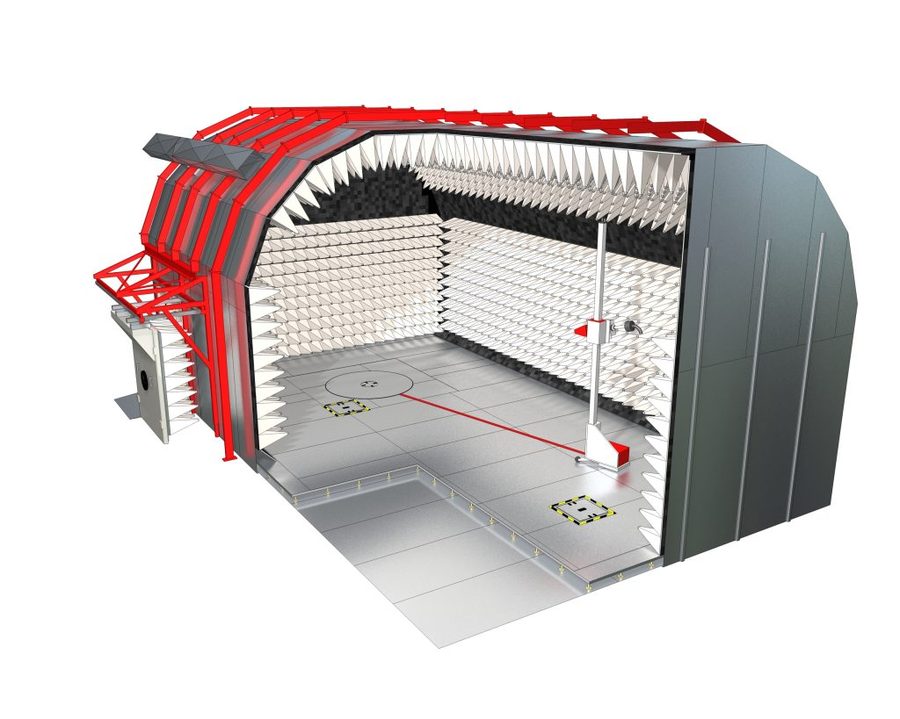
Frankonia SAC-5 Plus
A dome-roof chamber with two measurement distances in one room: 5 m for equipment up to the 2.0 m by 2.0 m volume of the table, and 3 m for everything that still qualifies as a small EUT.
- Quiet zone of 2.0 m or 3.0 m, so the validated volume is never the limiting factor at 5 m, with room for the cables that count towards the EUT volume
- NSA within ±3.5 dB and site VSWR within 5.5 dB, guaranteed, against the 4 dB and 6 dB of CISPR 16-1-4
- External size 12.7 m by 8.2 m by 6.3 m for the L variant, the same height class as a 3 m chamber
- Turntable load up to 5 t, for cabinets, racks and floor-standing machines
- One lining for CISPR 11, 14, 15, 25 and 32 and for MIL-STD-461, with the Frankosorb hybrid absorbers keeping the walls thin
Equipment larger than 2.0 m belongs at 10 m, where Frankonia's SAC-10 range applies. Quotations on request.
What to check this year
ICX Lab is the authorised distributor for Frankonia chambers, and the Frankonia page sets out the range by product type, from the 3 m chamber for small equipment to the 10 m chambers for machines. Whichever chamber it is, the site validation that establishes its test volume is work we do on site under an accredited scope. If you are unsure which distance your product range needs, send us the dimensions of your three largest products with their cables.