Consumer products · CISPR 32, CISPR 35, CISPR 14, CISPR 15, EN 301 489

A consumer product immunity laboratory, run from one controller

Multimedia, household appliances, lighting and radio equipment share one set of immunity tests: radiated fields, ESD, burst, surge, dips and conducted RF. Two systems cover them. Radiated immunity: the NSG 6000A driving two CBA amplifiers and one antenna from 80 MHz to 6 GHz. Transients and conducted immunity: the NSG 3040A, the NSG 4070C and the dito.

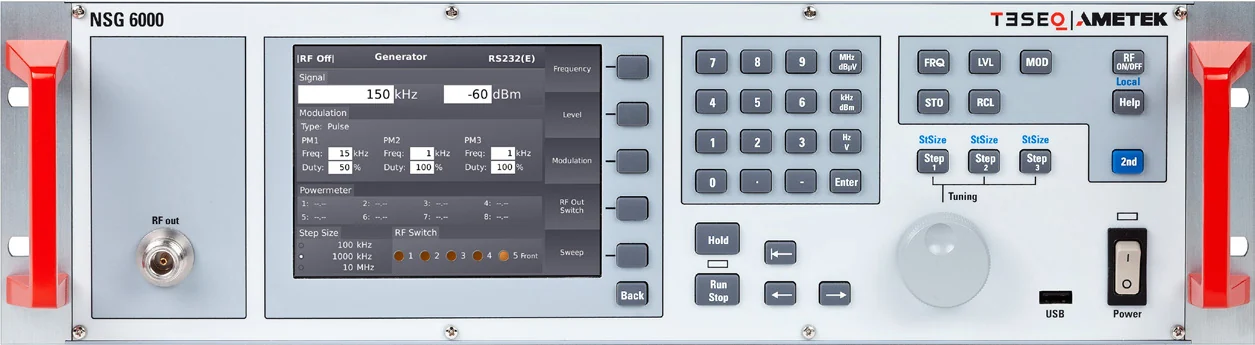
Teseq NSG 6000A radiated and conducted immunity test systemNSG 6000A: generator, switch matrix and power-meter interface in one 3U unit
Radiated immunity · IEC 61000-4-3, 80 MHz to 6 GHz

One controller, two amplifiers, one antenna

The NSG 6000A routes its signal to the right amplifier through its own switch matrix and reads the power meters directly, so the whole chain from 80 MHz to 6 GHz behaves as one instrument. That covers the 3 V/m residential level of CISPR 35 and CISPR 14-2, the 10 V/m industrial level, and the bands above 1 GHz that EN 301 489 adds for radio equipment.

Teseq NSG 6000A radiated and conducted immunity test system
Star product

NSG 6000A

Signal generator, RF switch network, power-meter interface and EUT monitoring in one 3U unit.

  • Generator 9 kHz to 6 GHz
  • Built-in switch network with five RF outputs, and SPDT or SP6T switches to combine amplifiers into one antenna path
  • Reads up to eight PMR 6003 or PMR 6006 power meters directly
  • Three pulse modulators for radar profiles
  • Four digital and one analogue EUT monitoring inputs, 14 control outputs
  • About 11 kg
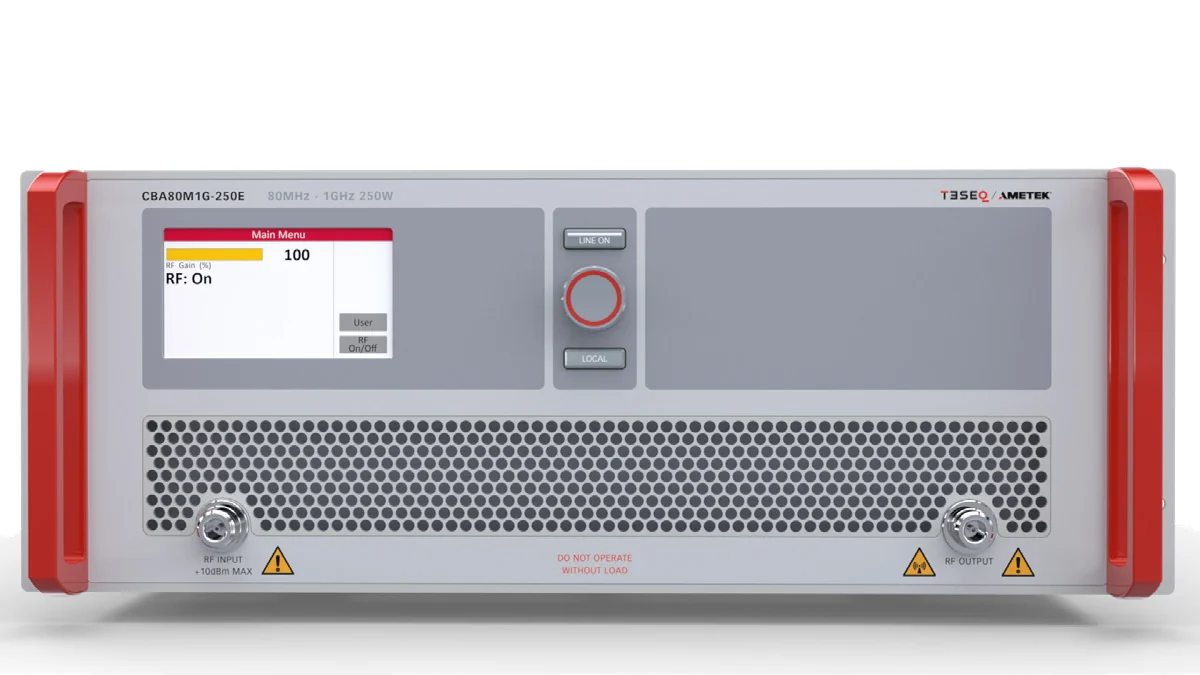
Teseq CBA80M1G E series solid-state amplifier
80 MHz to 1 GHz

CBA 80M1G E series

Single-band class A amplifiers built on the AR design, sized from bench to rack.

  • 100 W to 975 W at 1 dB compression
  • CBA80M1G-125E: 3U, about 16 kg, 100 W P1dB
  • Colour touch panel for monitoring and diagnostics
  • Ethernet, USB, RS-232, optical RS-232 and GPIB
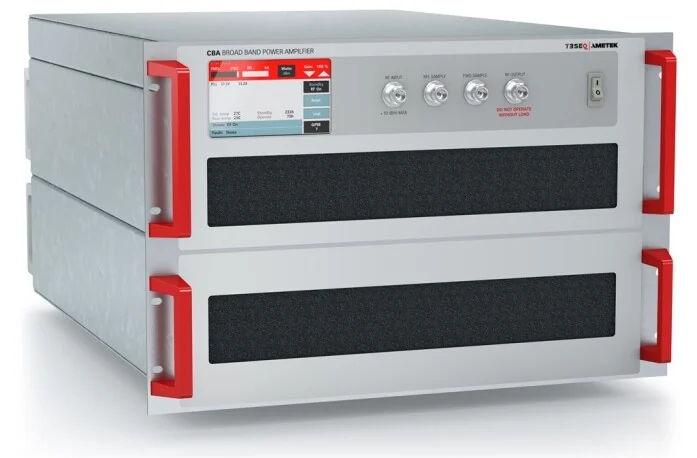
Teseq CBA6G-200D solid-state amplifier
0.8 GHz to 6 GHz

CBA 6G D series

Class A amplifiers from 30 W to 400 W for the bands above 1 GHz.

  • CBA6G-030D: 4U, 30 W P1dB
  • CBA6G-200D: 7U, 200 W P1dB
  • Built-in calibrated directional coupler for forward power
  • 100 percent mismatch tolerant, no foldback, three-year warranty
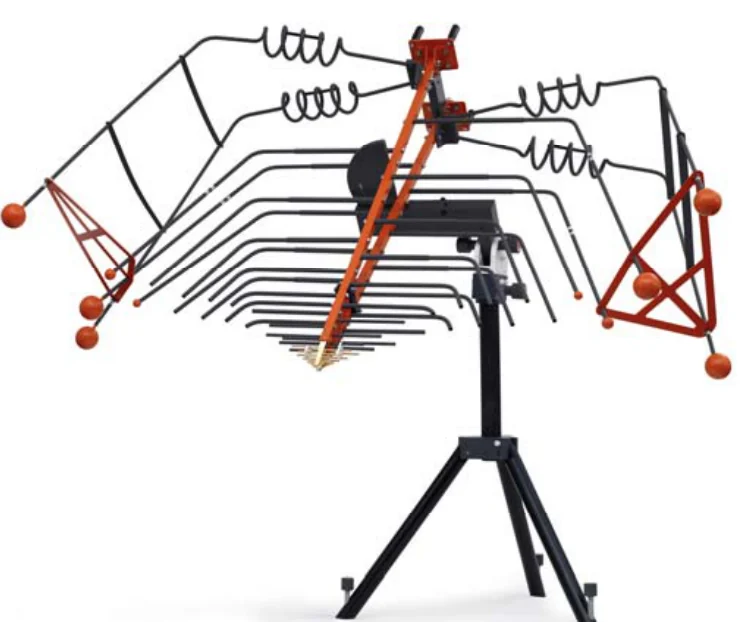
AR ATR26M6G-1 Radiant Arrow log-periodic antenna
26 MHz to 6 GHz

AR ATR26M6G-1 antenna

One log-periodic antenna for the whole range, with a bent-element design about 75 percent smaller than a conventional log-periodic.

  • 26 MHz to 6 GHz, gain 6 dBi from 80 MHz up
  • VSWR 3:1 maximum from 80 MHz to 6 GHz
  • 2.18 m wide, 13.6 kg, polarisation change on the positioner
  • Small enough to limit room loading in a 3 m chamber
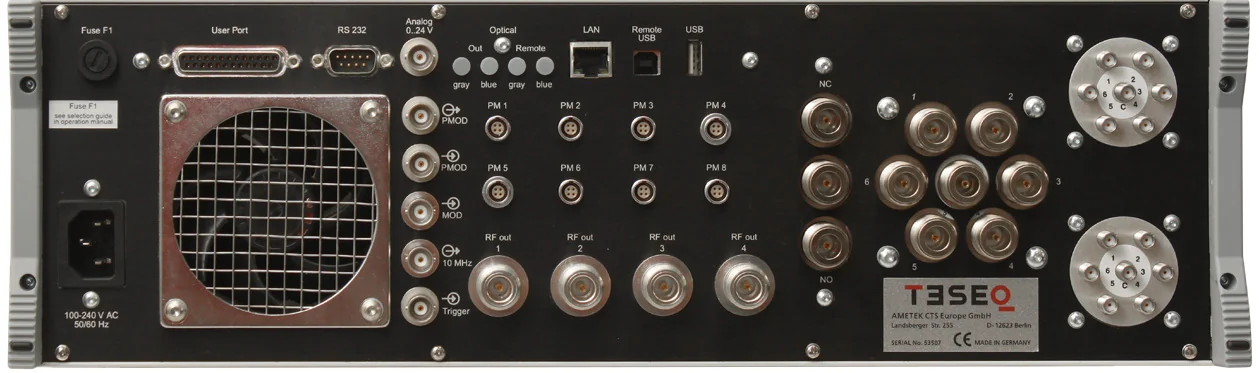
NSG 6000A rear panel with generator outputs, switch options and power meter inputs

The rear panel is the system

What an assembled bench spreads over a switch box, a power meter mainframe and a monitoring unit is on the back of the NSG 6000A.

  • Four generator outputs plus the front output, one per amplifier
  • Factory-fitted SPDT and SP6T switches, N or SMA, to bring two amplifiers to one antenna
  • Power meter inputs for four PMR heads, eight as an option
  • User port, analogue input and optical port for EUT monitoring
  • LAN, USB, RS-232 and optical remote control
The pain point

Two amplifiers, one antenna, and a bench full of boxes in between

Covering 80 MHz to 6 GHz needs two amplifiers. In an assembled set-up, everything that joins them is another box, another cable and another driver.

Conventional: generator, switch box, meter mainframe, monitor

The generator, the RF switch box, the power meter mainframe and the EUT monitor are separate purchases with separate remote interfaces.

PC and softwareSignal generatorRF switch box Amplifier 1Amplifier 2Combiner switch Power meter mainframeEUT monitor unitEUT drivers for every box9 kHz to 6 GHzseparate controller 80 MHz to 1 GHz0.8 to 6 GHzthen the antenna two heads, GPIBown interfaceconsumer product seven control and readback links, four interface types
9boxes on the bench
7remote links to keep alive
4interface types, GPIB to LAN
  • The switch box and the meter mainframe are the two items that fail first and stop the whole chain
  • Every band change is a software handshake across three vendors' drivers
  • Forward power comes from one instrument, field level from another, and the PC reconciles them
  • EUT monitoring is a separate unit with its own cabling to the chamber

Integrated: NSG 6000A with CBA amplifiers and the antenna

Switching, power reading and EUT monitoring are inside the generator. The amplifiers and the antenna are the only other boxes.

NSG 6000A GeneratorRF switch matrixPower meter interface, 8 headsEUT monitoring one LAN link to the Nexio BAT-EMC software CBA 80M1G ECBA 6G DATR26M6GEUT 80 MHz to 1 GHz0.8 to 6 GHzvia SPDT switchconsumer product PMR heads read back into the generator
4boxes, generator to antenna
1remote link for the whole system
0external switch or meter units
  • The switch matrix selects the amplifier per frequency, inside the generator
  • Up to eight PMR power meter heads plug straight into the rear panel and are read with the generator's own timing
  • EUT monitoring and the optical chamber link are on the same unit
  • Nexio BAT-EMC controls one instrument, and the amplifiers report through it
Our strengths · Radiated immunity

Why we lead with the NSG 6000A for consumer products

The CBA 80M1G E and CBA 6G D amplifiers and the ATR26M6G antenna cover 26 MHz to 6 GHz between them. The reasons to choose this system over an assembled one are in the controller.

One 3U box instead of three

Generator, switch matrix, power-meter interface and EUT monitoring in one 11 kg unit. Assembled another way, the same functions are a signal generator, a switch platform and a power-meter mainframe, each with its own cabling, driver and calibration.

The switch matrix is built in

Five RF outputs and factory-fitted SPDT or SP6T switches mean two amplifiers reach one antenna without an external switch box or its controller.

Power meters plug into the generator

Up to eight PMR 6003 or PMR 6006 heads connect directly. Forward, reverse and field-sensor readings arrive at the instrument that sets the level, with no mainframe in between.

Grows without changing the controller

The amplifiers are sized to the field level and distance at quotation. When a customer later moves from residential to industrial levels or adds radio-equipment bands, a larger amplifier drops into the same switch position, with the same controller and the same antenna.

EUT monitoring stays on the instrument

Four TTL inputs, ten TTL outputs, four open-drain outputs, an analogue input and an optical link to the chamber, more monitoring I/O than any separate switch platform or controller offers, and no data-acquisition card to add.

Not tied to one vendor's software

The NSG 6000A runs under Nexio BAT-EMC, with its driver library of more than 500 instruments, as well as AMETEK's own software. Some competing stacks only work with the same maker's generator and software, so the whole bench is bought together and replaced together.

Transients and conducted immunity · IEC 61000-4-2, -4-4, -4-5, -4-6, -4-11

The rest of the CISPR 35 table, from three instruments

Burst, surge and dips come from one generator with its own coupling network. Conducted RF comes from the NSG 4070C with a CDN, and ESD from a battery-powered simulator. Together with the radiated system, that is every immunity row in CISPR 35, CISPR 14-2 and IEC 61547.

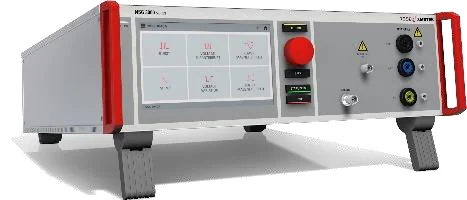
Teseq NSG 3040A multifunction generator
Burst, surge, dips

NSG 3040A

Surge, EFT burst and power quality tests in one box, with a 7-inch touch screen and the coupling network inside.

  • Combination wave surge to 4.8 kV and EFT burst to 4.8 kV at up to 1 MHz, well above the 1 kV and 2 kV consumer levels
  • Dips and interrupts to 0 percent, 500 A inrush
  • Built-in single-phase CDN, 300 V AC or DC, 16 A, so most consumer products connect straight to the front panel
  • Test Assistance starts a standard test in a few taps, and parameters can be changed while the test runs
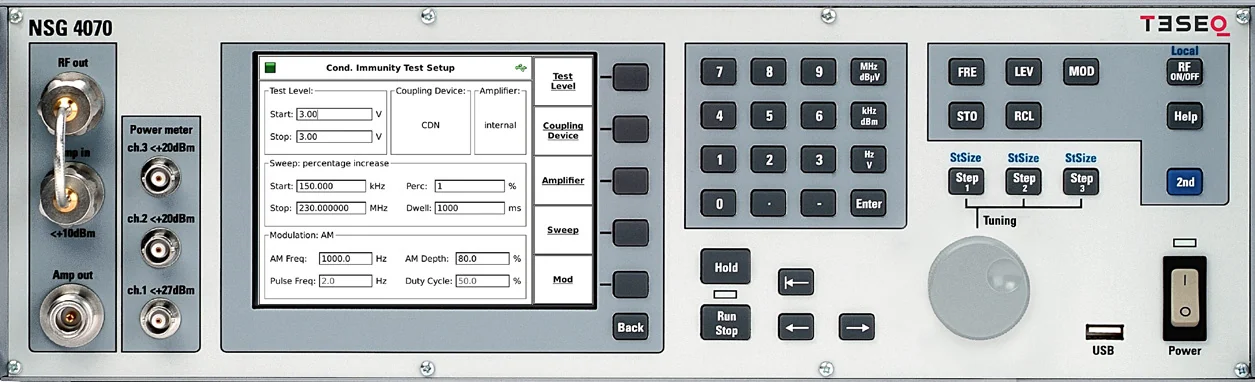
Teseq NSG 4070C conducted immunity test system, front panel
Conducted RF, IEC 61000-4-6

NSG 4070C with CDN M016

Generator, amplifier and three power meters in one unit, run from its own screen, with one coupling network that switches between two-line and three-line mains ports.

  • 3 V and 10 V from 150 kHz to 80 MHz, and to 230 MHz where a product standard asks
  • Internal amplifier options to 110 W
  • Level setting stored as a calibration file per CDN
  • CDN M016: switchable M2 or M3, L and N or L, N and PE, 16 A, 150 kHz to 230 MHz
  • One network covers class I and class II appliances, with no CDN change between them
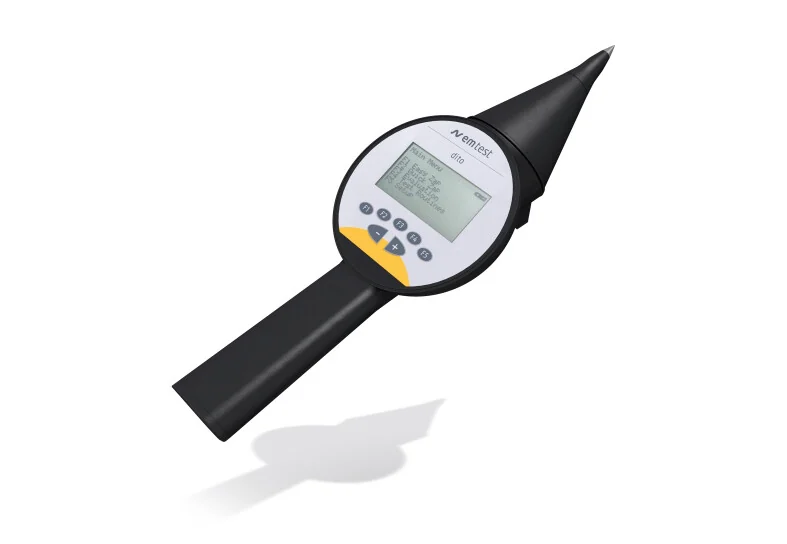
EM TEST dito ESD simulator
ESD, IEC 61000-4-2

dito

A hand-held 16 kV ESD simulator with the battery in the gun, for the 4 kV contact and 8 kV air levels of consumer products with margin to spare.

  • Contact discharge to 10 kV, air discharge to 16.5 kV
  • About 870 g including the battery, no base station or mains lead
  • LiFePO4 power pack for more than 70,000 discharges at 16.5 kV
  • Interchangeable R/C networks and tips, esd.control library of standard routines
The pain point

Three generators, a coupling network and a variac, for three tests

Burst, surge and dips are three instruments in an assembled bench, plus the network that joins them to the mains and a PC to sequence them. Every product that arrives means re-cabling the coupling network.

Conventional: a generator per test

Separate surge and burst generators, a dips unit with a variac, an external coupling network and a PC to run the sequence.

PC and softwareLaboratory mains Surge generatorBurst generatorDips unit and variac Coupling networkEUT runs three boxesthrough the network own caseown caseown case, heavy re-cabled per testconsumer product three control links, and the coupling network re-wired for each test
5boxes on the bench
3times the mains is re-cabled
1laptop to sequence it all
  • Each generator has its own case, its own mains lead and its own place in the sequence
  • The coupling network is re-wired between surge, burst and dips
  • A three-phase or high-current appliance needs a different network again
  • Reports are assembled from three instruments' logs afterwards

Integrated: NSG 3040A with its built-in coupling network

One generator couples surge, burst and dips through its own 16 A network, and drives external networks for larger products.

NSG 3040A Surge 4.8 kVBurst 4.8 kVDips, interruptsCoupling network, 16 A, 300 V 7-inch touch screen, Test Assistance External CDN3-phase, high current EUTconsumer product One screen: pick the standard, run, read the report
1generator for three tests
1mains connection for all of them
0re-cabling between tests
  • Surge, burst and dips run from one mains connection through the internal 16 A network
  • Test Assistance starts the standard test in a few taps, and the thumbwheel changes a parameter while the test runs to find a threshold
  • A three-phase or higher-current appliance moves to an external coupling network driven by the same generator
  • Test reports are written on the instrument as the test proceeds
Our strengths · Transients and conducted immunity

Why we lead with the NSG 3040A for consumer benches

Three tests, one box, one mains lead

Surge, burst and dips share the NSG 3040A's internal 16 A coupling network, so a product is connected once for the whole CISPR 35 transient set.

Margin above the consumer levels

4.8 kV burst and 4.8 kV surge against the 1 kV and 2 kV the standards ask for, so the same generator serves an industrial product later.

Find the threshold on the spot

Parameters can be changed while the test runs, so a development test ends with the level at which the product fails, not just a pass or a fail.

One CDN for class I and class II

The CDN M016 switches between two and three lines, so a double-insulated appliance and an earthed one use the same network. The NSG 4070C stores a calibration file per setting and runs the sweep from its own screen.

ESD that is comfortable all day

The dito weighs about 870 g with its battery in the gun, with no base station and no mains lead, and its power pack lasts more than 70,000 discharges. Consumer products have many test points, and the operator feels the difference.

Supported and calibrated here

ICX Lab Services installs the bench, trains the team and calibrates the generators, coupling networks and ESD gun on site under the accredited scope.

Test coverage

Consumer product immunity tests these two systems perform

Levels shown are the residential values of CISPR 35 and CISPR 14-2. Industrial levels and the radio-equipment bands of EN 301 489 use the same equipment with the larger amplifier. Emission measurement to CISPR 32, 14-1 and 15 needs an EMI receiver, LISN and antennas, which we quote separately.

TestStandardTypical requirementEquipment
Radiated immunity
Radiated RF fieldIEC 61000-4-3, CISPR 35, CISPR 14-23 V/m, 80 MHz to 1 GHz, AM 80 percentNSG 6000A, CBA 80M1G E, ATR26M6G antenna
Radiated RF field above 1 GHzCISPR 35, EN 301 489-13 V/m in the bands to 6 GHzNSG 6000A, CBA 6G D, ATR26M6G antenna
Radiated RF field, industrialIEC 61000-6-210 V/m, 80 MHz to 1 GHz, 3 V/m to 6 GHzSame system with larger CBA amplifiers
Transients and conducted immunity
Electrostatic dischargeIEC 61000-4-24 kV contact, 8 kV airdito
Electrical fast transientIEC 61000-4-41 kV mains, 0.5 kV signal linesNSG 3040A
SurgeIEC 61000-4-52 kV line to earth, 1 kV line to lineNSG 3040A
Conducted RFIEC 61000-4-63 V, 150 kHz to 80 MHzNSG 4070C with CDN M016
Voltage dips and interruptionsIEC 61000-4-110 percent, 40 percent and 70 percent dipsNSG 3040A
Power-frequency magnetic fieldIEC 61000-4-81 A/m to 3 A/mMFG 40 with MFC loop, optional

Setting up a consumer product immunity laboratory?

Tell us the product families and the standards your customers cite. The amplifiers are sized to the field level and distance at quotation. We add the transient bench and calibrate everything on site after delivery. Quotations on request.

Request a quotation   WhatsApp us

Tell us what you need to test

We reply within one working day with a quote or a plan.

Contact us